
A person may like your website. They may like your photos, your list of services, and the way you explain your process. Before they take the next step, they still want to know one thing:
What did real customers or patients experience?
That is where reviews do a lot of heavy lifting.
A good review can answer questions your website cannot answer as well on its own. Was the team kind? Did they return calls? Did they explain things clearly? Did the project go smoothly? Did the patient feel comfortable? Did the customer feel respected?
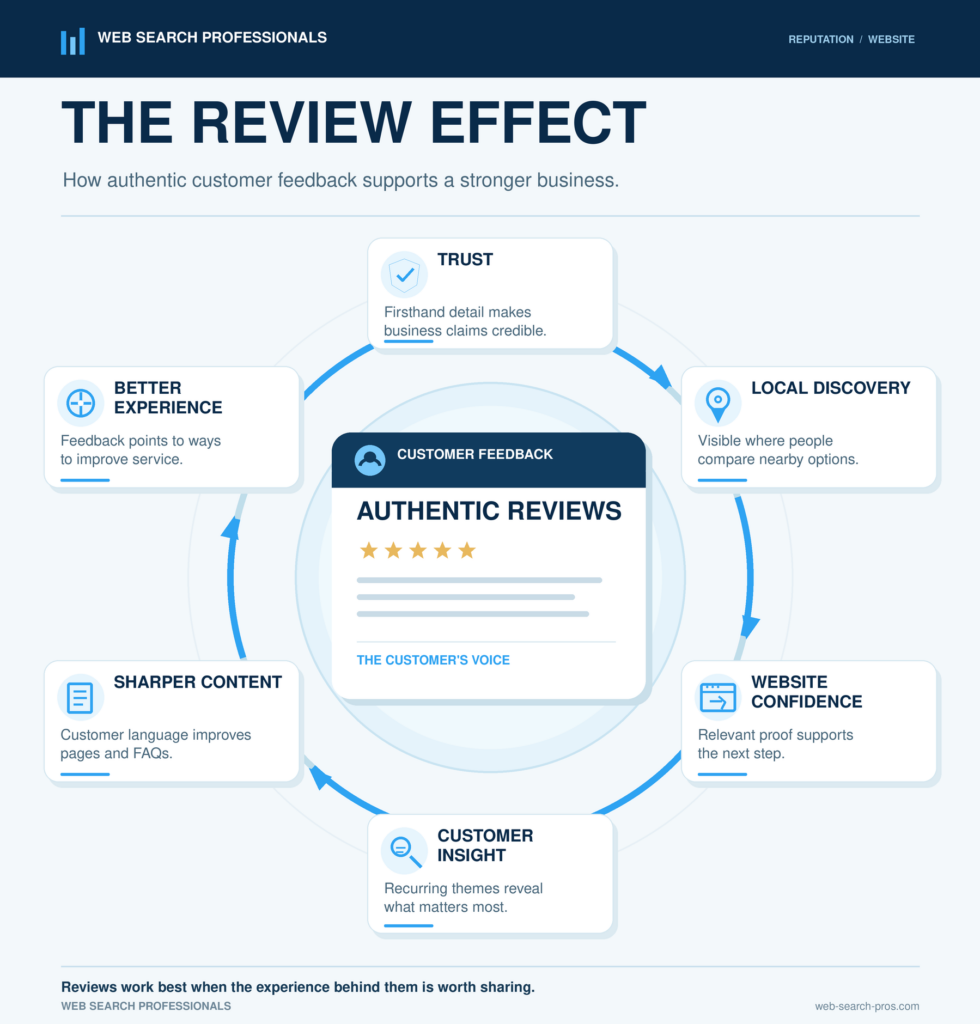
When reviews are collected regularly and used well, they help people feel more comfortable choosing your business. They can also support your local visibility, strengthen your website, and give you better language for your marketing.
The goal is simple: ask for reviews in a respectful way, respond professionally, and place them on your website where they help people make a decision.
Why online reviews matter
Reviews matter because they help people decide whether your business feels safe, capable, and worth contacting.
1. Reviews build confidence before someone reaches out
Most people are careful before they call a business they do not know. They want proof that you do what you say you do.
Your website can say you provide excellent service. A customer review can show what that actually looked like.
For example:
A business might say: We provide excellent service.
A review might say: They answered every question, showed up when they said they would, kept the area clean, and made the whole process easier than I expected.
The review feels more believable because it came from someone who experienced the business firsthand.
For a dental practice, a review about a calm, friendly appointment can help a nervous patient. For a roofing company, a review about cleanup and communication can help a homeowner. For a law firm, a review about patience and clear guidance can help someone who is already dealing with stress.
2. Reviews can help local search visibility
Google reviews matter because they show up directly in Google Search and Google Maps. When someone compares several local businesses, the review count, rating, recent feedback, and owner responses can all influence who gets the call.
Reviews also give Google and other platforms more context about your business. If customers mention services, locations, neighborhoods, problems solved, or the type of experience they had, that language can help search engines better understand what your business does.
Reviews alone will not guarantee rankings. Local visibility depends on many things, including your website, Google Business Profile, location, competition, content, citations, links, and overall reputation. Still, reviews are an important part of the local marketing picture.
3. Reviews help your website turn visitors into leads
Getting people to your website is only the first step. Once they arrive, your site has to help them feel ready to act.
Reviews can help on pages where people are making a decision, including:
- Homepage
- Service pages
- Location pages
- Contact page
- Appointment request page
- Consultation page
- Product pages
- Case studies
- Blog posts
- Landing pages for ads
A review placed near a contact form, appointment button, or consultation request can give someone the extra confidence they need.
A patient reading about dental implants may feel better after seeing a review that talks about comfort, explanation, and trust. A homeowner reading about roof replacement may feel better after seeing reviews that mention communication, workmanship, and cleanup.
4. Reviews show what customers actually value
Reviews are also useful research.
Business owners often think their biggest advantage is equipment, software, pricing, training, or years in business. Customers may care more about how fast you responded, how clearly you explained their options, or how easy you made the process.
Look for repeated phrases and themes in your reviews, such as:
- Friendly staff
- Clear communication
- Fast response
- Professional work
- Clean job sites
- Comfortable experience
- Fair pricing
- Helpful explanations
- Easy scheduling
- Honest recommendations
- Follow-through
Those themes belong in your marketing. They can shape your website copy, service pages, social posts, email campaigns, ads, FAQs, and sales conversations.
5. Reviews help you stand apart from similar businesses
Many local websites sound almost the same. They list the same services, make the same claims, and ask people to call for a quote.
Reviews add detail that your competitors may not have. If customers keep describing your team as careful, honest, responsive, thorough, patient, or easy to work with, those words become part of your reputation.
That kind of proof has to be earned, which is why it matters.
Where to collect reviews
The best review platforms depend on your business, your industry, and where your customers already look for information.
Common review sources include:
- Google Business Profile
- Yelp
- Better Business Bureau
- Healthgrades
- Zocdoc
- Avvo
- Angi
- Houzz
- HomeAdvisor
- TripAdvisor
- Industry-specific directories
- Testimonials collected directly from customers
For most local businesses, Google should be a priority because those reviews appear in search results and map listings. Still, it is smart to think beyond one platform. A healthy reputation system may include Google reviews, industry directory reviews, and first-party testimonials you can use on your own website with permission.
How to ask for reviews without making it weird
A lot of businesses want more reviews, but they do not have a simple way to ask. So they ask once in a while, forget for a few months, and wonder why competitors have more recent feedback.
The businesses that get steady reviews usually have a steady process.
Ask at the right time
The best time to ask is when the customer has just had a good experience.
Good moments include:
- After a successful appointment
- After a completed project
- After a customer compliments your team
- After a product delivery
- After a service call is resolved
- After a helpful consultation
- After a repeat customer comes back again
If someone says, ‘Your team did a great job,’ that is a natural opening.
You can respond with something simple:
‘Thank you. That means a lot. If you would be comfortable sharing that in a review, it would really help other people who are deciding who to call.’
That sounds human because it is direct and honest.
Make it easy
Do not make customers search for the right place to leave a review. Send one clear link when platform rules allow it.
A simple request could say:
‘Thank you for choosing us. If you had a good experience, would you consider leaving us a Google review? Reviews help other people understand what it is like to work with our team.’
Keep the message short. One link is usually better than giving people five options.
Use the channels your customers already use
Review requests can work through:
- Email follow-ups
- Text messages
- Printed cards
- Receipts or invoices
- QR codes at checkout
- Post-appointment messages
- Project completion emails
- Customer service follow-up calls
- Marketing automation workflows
The right channel depends on your business. Dental practices may use post-appointment texts or emails. Contractors may ask at project closeout and follow up with an email. Manufacturers or B2B firms may ask after a successful delivery, installation, or milestone.
A personal ask followed by a simple reminder often works best.
Give your team the words
Review requests should not fall only on the owner or marketing person. Front desk staff, hygienists, project managers, technicians, account managers, salespeople, and customer service teams may all have good moments to ask.
Give them a comfortable script:
‘We’re glad everything went well. Reviews help people feel more confident when they’re choosing a business. If you’re comfortable leaving one, I can send you the link.’
That is polite, clear, and pressure-free.
What to avoid when collecting reviews
Review collection should be honest and compliant with the rules of each platform.
Avoid these mistakes:
- Do not write fake reviews.
- Do not ask employees to pretend they are customers.
- Do not pressure people into leaving positive reviews.
- Do not offer incentives unless you understand the platform rules and disclosure requirements.
- Do not use a review gate that only sends happy customers to public platforms.
- Do not copy reviews from third-party platforms without checking usage rules.
- Do not share private customer, patient, or client information in review requests or responses.
Some industries need extra care. Dental practices, healthcare offices, law firms, financial professionals, and other regulated businesses have privacy and advertising rules to consider.
If a review mentions treatment details, legal issues, money problems, medical concerns, or other sensitive information, be careful about how you use it.
This article is marketing guidance, not legal advice. If your industry has compliance requirements, have a qualified professional review your process.
How to respond to reviews
Your review responses are public. Future customers read them. That means your response is part customer service and part marketing.
Responding to positive reviews
Positive review responses should be sincere and brief.
Example:
‘Thank you for taking the time to share your experience. We appreciate the kind words and are glad our team could help.’
For healthcare, dental, legal, financial, or sensitive services, avoid confirming private details. Even if the reviewer mentions specifics, your response can stay general.
Responding to negative reviews
Negative reviews are frustrating. Take a breath before responding.
The goal is to show future readers that you are professional, calm, and willing to address concerns.
A good response should:
- Stay calm
- Acknowledge the concern
- Avoid arguing online
- Avoid sharing private details
- Invite the person to contact your business directly
- Show that you take feedback seriously
Example:
‘Thank you for sharing your feedback. We take concerns seriously and would appreciate the opportunity to learn more. Please contact our office directly so we can review the situation with you.’
A defensive response can make things worse. A measured response can protect trust, even when the review is difficult.
How to display reviews on your website
Collecting reviews is valuable. Showing them in the right places on your website makes them work harder.
A visitor should not have to leave your website to see that real people trust your business. At the same time, reviews should support the page instead of overwhelming it.
Good review placement is part of good website design. Beautiful web design starts with what the visitor needs in that moment. Sometimes they need a clean layout. Sometimes they need a better service page. Sometimes they need proof from real customers before they feel ready to call.
Add reviews to the homepage
Your homepage should quickly explain who you help, what you do, where you serve, and why people should trust you.
A homepage review section can include:
- A simple headline such as What Customers Are Saying
- Three to six strong reviews
- First name, initials, or approved identifier
- Star rating where allowed
- Review source, such as Google or Facebook
- Link to the original review platform
- Nearby call to action
Keep the design clean and readable. Reviews should look good on desktop and mobile.
Add service-specific reviews to service pages
A service page is stronger when the reviews match the service.
Examples:
- A dental implant page can feature reviews about comfort, explanation, and confidence.
- A roof replacement page can feature reviews about workmanship, cleanup, and communication.
- An HVAC repair page can feature reviews about fast response and problem-solving.
- A law firm practice area page can feature reviews about guidance and professionalism, while staying mindful of advertising rules.
Relevant reviews help visitors see that your team has handled the exact kind of work they are considering.
Build a dedicated reviews or testimonials page
A reviews page gives people one place to evaluate your reputation.
A strong reviews page may include:
- Embedded reviews or carefully selected testimonials
- Links to third-party review platforms
- A short note about your service standards
- A prompt for current customers to leave a review
- A contact, appointment, quote, or consultation call to action
- Filters by service, location, or customer type if you have a large review library
This page can also be helpful when someone searches for your business name plus the word reviews.
Place reviews near calls to action
Reviews are especially useful near decision points.
Consider adding a short testimonial near:
- Appointment request forms
- Contact forms
- Quote request forms
- Consultation buttons
- Pricing information
- Financing information
- Download pages
- Landing pages for paid ads
When someone is close to taking action, a strong review can reduce hesitation.
Use video testimonials when they make sense
Video testimonials can be very effective because people can see and hear the customer. They also need to be handled carefully.
Before using a video testimonial, get written permission. Be clear about where the video may appear, such as your website, social media, email, or ads.
Good questions include:
- What problem were you trying to solve?
- Why did you choose us?
- What stood out about the experience?
- What would you tell someone who is considering working with us?
For dental, healthcare, legal, financial, and other sensitive industries, permissions and privacy rules are especially important.
How to use reviews in blog content
Reviews can make blog posts more useful when they are used naturally.
A blog post should answer questions, explain options, and help the reader take a smart next step. Reviews can support that by showing how the advice connects to real customer experiences.
Use review themes to choose blog topics
Your reviews can tell you what people care about most.
If customers keep mentioning communication, write about what to expect during your process. If patients mention comfort, write about how your team helps people feel at ease. If customers mention quick response, write about how to handle urgent service needs.
Review themes can lead to blog topics such as:
- What to Expect During Your First Visit
- How We Keep Projects Organized from Estimate to Completion
- Questions to Ask Before Choosing a Local Contractor
- How We Help Patients Feel Comfortable During Dental Treatment
- Why Communication Matters During a Website Project
That is practical content because it comes from real customer concerns.
Add a relevant review inside the article
One good review can support a blog post without making the article feel like a sales pitch.
If a post explains emergency dental care, include a review that mentions compassion and responsiveness. If a post explains a roofing process, include a review about scheduling, cleanup, and communication. If a post explains website design, include a review about clarity, organization, and follow-through.
One or two reviews are usually enough.
Link to related service pages and your reviews page
Your blog should help readers move through your website.
A useful blog structure might include:
- A clear introduction
- The problem or question being answered
- Practical advice
- A relevant customer review
- Link to the related service page
- Link to the reviews page
- Clear call to action
That gives readers a natural path from learning to contacting you.
Turn strong reviews into other content
With permission, reviews can support more than your website.
They can be used in:
- Case studies
- Project spotlights
- FAQ articles
- Social media posts
- Email newsletters
- Website banners
- Service page proof sections
- Sales presentations
Be careful when editing. You can shorten a review for space, but do not change the meaning.
Website design tips for review sections
A review section should be easy to read and easy to trust.
Use these guidelines:
- Use real names, initials, or approved identifiers.
- Show the review source when appropriate.
- Keep review cards clean and simple.
- Use readable font sizes.
- Make sure the color contrast is strong.
- Check how reviews look on mobile.
- Do not let review widgets slow down the page.
- Link to the original review platform when possible.
- Place reviews close to the service or topic they support.
- Refresh reviews from time to time.
- Make the section accessible for screen readers and keyboard navigation.
A few strong reviews in the right places usually work better than a huge wall of testimonials.
Technical considerations for reviews on your website
Review sections can create website problems when they are added without planning.
Watch for:
- Slow review widgets
- Broken third-party embeds
- Review feeds that fail on mobile
- Layout shifts while the page loads
- Sliders that are hard to use
- Duplicate review blocks across too many pages
- Review schema that is inaccurate or misleading
If your website uses structured data, make sure it follows search engine guidelines. Review markup should be accurate, visible to users, and connected to real reviews.
A good review section should help visitors and search engines understand your credibility without slowing down the site or cluttering the page.
A simple review collection workflow
Here is a practical workflow most businesses can adapt:
- Choose the review platform you want to prioritize first. For many local businesses, that will be Google Business Profile.
- Create a direct review link.
- Train your team on when and how to ask.
- Add the review request to your normal process after appointments, projects, deliveries, or service calls.
- Send a short email or text with the review link.
- Check new reviews weekly.
- Respond professionally.
- Save strong reviews in one central place.
- Add selected reviews to the right website pages.
- Use review themes for blogs, social posts, FAQs, and ads.
Consistency is the difference. A business that asks every week will usually build a stronger review profile than one that remembers a few times a year.
How Web Search Professionals helps with reviews, websites, and reputation content
Our team helps small and mid-sized businesses improve how they are found, understood, and chosen online. Reviews are a major part of that work.
We help businesses build better review systems, improve website trust, create stronger service pages, and turn customer feedback into useful content. We also connect review strategy to SEO, AI visibility, local search, social media, marketing automation, analytics, and website design.
That can include:
- Review request strategy
- Google Business Profile optimization
- Website review section planning
- Reviews and testimonials page creation
- Blog content based on customer questions and review themes
- Local SEO support
- Website design updates
- Marketing automation workflows
- Analytics and tracking
- AI-search optimization for clearer, better-structured content
For dental practices and other local service businesses, reviews should be part of the website conversation. An aging, slow, or unclear website can make it harder for visitors to evaluate your business. Sometimes a full rebuild makes sense. Other times, focused updates can remove the biggest friction.
That may mean better photos, clearer service pages, faster load times, simpler mobile navigation, stronger calls to action, or better placement of reviews near appointment and contact forms.
Marketing VIP creates beautiful and functional websites and e-commerce stores. The goal is a site that looks professional, works smoothly, and gives visitors the information they need before they contact you.
Start with your review system
If you want more reviews, start with a clear process.
Decide when to ask, who will ask, where customers should leave the review, how your team will respond, and where your best reviews should appear on your website.
Then look at your website through the eyes of a new visitor. Can they quickly understand what you do? Can they see proof that people trust you? Can they find the right service page? Can they contact you easily from a phone?
Those details matter.
Web Search Professionals can help you build a review strategy that supports trust, local visibility, website performance, and stronger content across your marketing channels.
Schedule a free consultation at Contact Us to talk through your review collection process, website display strategy, and reputation marketing opportunities.